 comparison
Guest Data Platform Demo: What to Expect
Table of Contents
- Why a Guest Data Platform Demo Matters
- What a Guest Data Platform Actually Does
- Integrating CDP with Hotel PMS: What You Need to Know
- Guest Data Platform Features Checklist for Your Evaluation
- Guest Data Platform Implementation Timeline: From Demo to Launch
- FADP Compliance for Hotel Guest Data: Security You Can Trust
- Questions to Ask During Your Demo
- Getting Started With Your Demo Today
Last Updated: August 11, 2026
Why a Guest Data Platform Demo Matters
A guest data platform demo reveals how modern hospitality transforms from reactive service into genuinely personalized experiences. Most luxury properties operate on fragments, preference notes in one system, booking history in another, communication scattered across email and phone calls. The demo shows what unified guest intelligence actually looks like in practice.
When a concierge knows a guest's preferred room temperature, dietary restrictions, and past service preferences before check-in, the entire stay changes. That's what a solid demo demonstrates: operational reality, not promises.
At The-Guest Club, we've built our platform specifically for luxury hospitality operators who refuse to compromise on personalization or privacy. A demo shows how a portable guest profile, hosted securely in Switzerland, gives your team the intelligence they need while guests retain control of their own data. This is how boutique hotels and private aviation operators are already delivering service that feels like genuine relationship.
What a Guest Data Platform Actually Does
A guest data platform is a centralized system that collects, unifies, and activates guest information across all your properties and touchpoints. Unlike traditional PMS systems focused on reservations and billing, a CDP focuses on guest intelligence, turning fragmented data into actionable insights.
Unified guest profiles and data activation
The foundation is the unified guest profile, a single record combining every interaction a guest has had with your properties: past stays, preferences, communication history, special requests, loyalty activity, and behavioral patterns. Instead of your concierge searching three systems to remember that a guest prefers hypoallergenic pillows and ocean-view rooms, that information surfaces instantly.
Data activation means your team uses this intelligence in real time. When a guest books their next stay, housekeeping receives their preference profile automatically. When they arrive, the front desk has flagged their preferred check-in time. When they request room service, the kitchen knows about dietary restrictions without asking.
The difference between a guest data platform and a basic CRM is that activation happens across channels and properties simultaneously. A note in one property's system becomes available to your entire organization. A preference expressed during one stay informs service at a different property.
Real-time synchronization across properties
For multi-property operators, real-time synchronization is the critical differentiator. When a guest updates their preference profile, that change reaches every property in your network within seconds, not through batch uploads the next morning.
Guest expectations have shifted. A traveler who prefers a firm mattress shouldn't re-specify that preference at every property. A guest with a severe shellfish allergy shouldn't repeat it to each chef. Real-time synchronization ensures context travels with the guest, regardless of which property they're visiting.
Synchronization requires strong API connectivity between your PMS, guest data platform, and ancillary systems. A solid demo walks you through exactly how that integration works with your actual systems.
Integrating CDP with Hotel PMS: What You Need to Know
A guest data platform doesn't replace your PMS. Instead, it extends it by creating a guest-centric layer that your PMS feeds data into and pulls insights from. Your PMS remains the system of record for reservations, billing, and operations. The CDP becomes the system of insight for personalization.
The integration typically flows in two directions. First, your PMS sends guest data to the CDP: reservation details, check-in/check-out times, room assignments, billing information, and recorded preferences. Second, the CDP sends enriched guest profiles back to your PMS and downstream systems like email, loyalty programs, or activity booking engines.
The demo should include a walkthrough of your specific PMS integration, not a generic example, but how the platform connects to your actual system. If your PMS isn't supported, that's a critical blocker. If it is, understand the implementation timeline and what data mapping will be required. Many integrations require standardizing how guest preferences are recorded; if your front desk uses 47 different ways to note room preferences, that needs standardization before the CDP can make sense of it.
A well-designed CDP has fallback mechanisms so your team can still access critical guest information even if your reservation system is temporarily offline. Ask about this during your demo.
Guest Data Platform Features Checklist for Your Evaluation
Focus on features that directly impact your team's workflow and guest experience.
Portable guest profiles should allow guests to control what information they share and with which properties. A guest should be able to say, "I want my dietary preferences shared with all properties in this chain, but my medical information stays private." The demo should show how intuitive this control is for guests.
Real-time preference synchronization across your properties is non-negotiable for multi-unit operators. The demo should show how quickly a preference change propagates through your system, seconds, not hours.
Behavioral analytics should reveal patterns in guest preferences and behavior: which guests consistently book corner suites, who always requests late checkout, which guests are most likely to book again. A solid demo includes sample dashboards showing how this data surfaces.
API connectivity determines what other systems your CDP can talk to. Check whether the platform integrates with your loyalty program, email marketing tool, activity booking system, and other critical systems.
Guest-facing profile management is critical for adoption. If guests can't easily update their own preferences through a mobile app or web portal, your team will manually update profiles, defeating the purpose.
Compliance and security controls should include role-based access and audit trails showing who accessed what data and when. For a Swiss-hosted platform, this is particularly important given local data protection standards.
Segmentation and targeted marketing capabilities allow you to group guests by behavior, preferences, or value and deliver targeted communications.
Guest Data Platform Implementation Timeline: From Demo to Launch
Implementation timelines vary depending on your infrastructure, data quality, and team readiness. A realistic demo includes discussion of your specific timeline.
For a small boutique hotel with a single PMS and clean data, implementation typically takes 6-12 weeks. For a multi-property group with legacy systems and fragmented data, expect 3-6 months. The biggest variable isn't the software, it's data preparation.
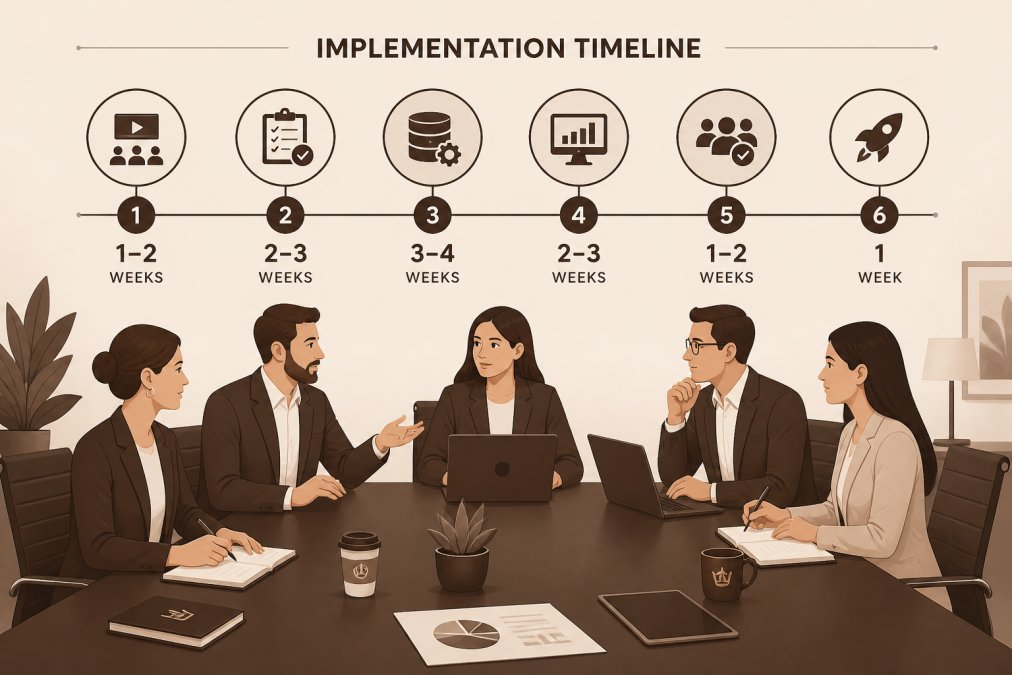
Most implementations follow a similar arc. Weeks 1-2 involve technical setup and API integration between your PMS and the CDP. Your IT team will configure authentication, map data fields, and test connectivity.
Weeks 3-4 focus on data migration and cleansing. If your PMS contains multiple spellings of "do not disturb," the CDP will surface that problem immediately. Most teams standardize how guest preferences are recorded before migration.
Weeks 5-8 involve team training and process redesign. Your concierge, front desk, housekeeping, and management need to understand how to use the platform. Guest preferences that used to live in handwritten notes now get structured into the system.
Weeks 9-12 are soft launch and optimization. You might start with a single property or subset of guests. This phase is critical; rushing to full deployment before working through integration gaps and workflow issues creates frustration and poor adoption.
The demo should include a realistic implementation roadmap specific to your situation.
FADP Compliance for Hotel Guest Data: Security You Can Trust
Guest data is sensitive information. How a platform handles it directly impacts your legal and operational risk. For properties operating in or serving guests from Switzerland, FADP (Federal Act on Data Protection) compliance is non-negotiable.
FADP requires that personal data be processed lawfully, fairly, and transparently. You need explicit consent before storing guest preferences, must allow guests to access and correct their data, and are responsible for ensuring data is protected against unauthorized access.
The demo should address several specific compliance questions. First, where is guest data physically stored? A Swiss-hosted platform keeps data within Switzerland, simplifying FADP compliance. Second, how does the platform handle data deletion? If a guest requests their profile be deleted, can the platform completely remove their data? FADP requires fulfilling deletion requests.
Third, what's the platform's incident response protocol? If there's a data breach, how quickly will you be notified? What's the liability structure? Fourth, does the platform support role-based access? Your housekeeping team shouldn't view guest payment information.
Ask for a copy of the platform's Data Processing Agreement (DPA). This legal document outlines how the platform handles your guest data and your obligations. If the vendor is hesitant to provide this, that's a red flag.
Ensure you can export your guest data in a portable format if you switch platforms. A platform that locks you in by making data export difficult is prioritizing retention over your interests.
Questions to Ask During Your Demo
A productive demo is a working session where you test whether the platform solves your problems. Come prepared with questions specific to your operation.

Start with your biggest operational pain point. If guests have to repeat preferences every time they book, ask specifically how the platform captures and surfaces those preferences across bookings.
Ask about integration with your existing systems. If you use a specific PMS, loyalty platform, or email tool, ask the vendor to show how that integration works. Ask whether they've implemented with your specific systems before.
Ask about adoption barriers. Many platforms fail because teams don't use them. Ask what training they provide.
Ask about scalability. If you're a 10-property group today and plan to expand to 20, will the platform handle that growth without rearchitecting?
Ask about costs beyond the subscription. Implementation fees, data migration, training, and integration development can often exceed the software cost. Get a comprehensive quote.
Ask for references from similar properties. Call them. Ask whether they'd choose the platform again and what surprised them during implementation.
Ask about the roadmap. What features are coming in the next 12 months? Is the vendor investing in areas that matter to you?
Getting Started With Your Demo Today
Before booking, clarify what you want to learn. Are you evaluating PMS integration? Understanding implementation timeline and cost? Assessing team adoption? Different questions require different demo formats.
Bring the right people: at least one technical person (to understand integrations), one operations person (to assess workflow impact), and one decision-maker (to evaluate strategic alignment).
Prepare a list of your current guest data sources and how they're currently used. This context helps the vendor tailor the demo to your reality.
During the demo, focus on your specific workflows. Ask the vendor to walk through how your team would actually use the platform on a typical day. How does your front desk check in a returning guest? How does your concierge fulfill a special request? How does housekeeping receive and act on guest preferences?
After the demo, debrief with your team before deciding. What did you learn? What questions remain? What concerns emerged?
The-Guest Club offers demos specifically designed for luxury hospitality operators. The team understands that your guests expect personalized service and that your team needs tools that simplify rather than complicate their work. A demo with The-Guest Club walks you through how a portable guest profile, combined with Swiss-hosted security and privacy-first design, transforms how your team delivers personalized experiences while keeping guest data under guest control.
A guest data platform demo answers a fundamental question: can technology actually improve how your team serves guests? The right platform integrates cleanly with your existing systems, respects guest privacy, and genuinely simplifies your team's workflow. It becomes invisible, just how you operate. That's what you're evaluating during the demo. Schedule yours with The-Guest Club and experience how modern guest intelligence works in practice.
Frequently Asked Questions
What should I look for during a guest data platform demo?
Focus on three core areas: how easily the platform unifies guest profiles from multiple sources, whether it integrates seamlessly with your existing PMS without major technical overhead, and how the interface handles real-time data synchronization. Ask for a walkthrough of the guest segmentation engine and how behavioral analytics translate into actionable marketing campaigns. Request a demonstration of the operational dashboard and verify that reporting reflects your specific KPIs. Finally, confirm that the demo includes a realistic scenario matching your property's size and complexity.
How does a guest data platform ensure FADP compliance for hotel guest data?
A compliant guest data platform implements privacy by design principles, ensuring data is encrypted both in transit and at rest. It should offer granular consent management, allowing guests to control what data is collected and how it's used. The platform must support data subject rights under FADP, including access, correction, and deletion requests. Look for platforms hosted in Switzerland with clear data processing agreements, regular security audits, and transparent breach notification procedures. Verify that the vendor maintains documented compliance with FADP requirements and can provide audit trails for regulatory review.
How long does guest data platform implementation typically take?
Implementation timelines vary based on your property's complexity and existing systems. A basic deployment for a single boutique property typically takes 4-8 weeks, including data migration, staff training, and initial testing. Multi-property hotel groups should expect 3-6 months to fully integrate across all locations, especially if legacy systems require data cleansing or API customization. The critical path includes PMS integration testing, guest adoption strategy, and staff onboarding. Request a detailed implementation roadmap during your demo that accounts for your specific infrastructure and identifies any potential bottlenecks early.
Can a guest data platform help with personalized marketing campaigns?
Yes. A guest data platform enables personalized marketing by creating unified guest profiles that capture preferences, booking history, and behavioral patterns. The platform's segmentation capabilities allow you to target guests with relevant offers based on their stay history, room preferences, or spending patterns. Real-time data activation means marketing campaigns can be triggered automatically, such as welcome messages for returning guests or personalized offers based on seasonal travel patterns. This drives higher engagement rates and improves direct booking conversion compared to generic mass communications. Ask for examples of automated workflows during your demo.
This article was written using GrandRanker
Frequently Asked Questions
What should I look for during a guest data platform demo?
Focus on three core areas: how easily the platform unifies guest profiles from multiple sources, whether it integrates seamlessly with your existing PMS without major technical overhead, and how the interface handles real-time data synchronization. Ask for a walkthrough of the guest segmentation engine and how behavioral analytics translate into actionable marketing campaigns. Request a demonstration of the operational dashboard and verify that reporting reflects your specific KPIs. Finally, confirm that the demo includes a realistic scenario matching your property's size and complexity.
How does a guest data platform ensure FADP compliance for hotel guest data?
A compliant guest data platform implements privacy by design principles, ensuring data is encrypted both in transit and at rest. It should offer granular consent management, allowing guests to control what data is collected and how it's used. The platform must support data subject rights under FADP, including access, correction, and deletion requests. Look for platforms hosted in Switzerland with clear data processing agreements, regular security audits, and transparent breach notification procedures. Verify that the vendor maintains documented compliance with FADP requirements and can provide audit trails for regulatory review.
How long does guest data platform implementation typically take?
Implementation timelines vary based on your property's complexity and existing systems. A basic deployment for a single boutique property typically takes 4–8 weeks, including data migration, staff training, and initial testing. Multi-property hotel groups should expect 3–6 months to fully integrate across all locations, especially if legacy systems require data cleansing or API customization. The critical path includes PMS integration testing, guest adoption strategy, and staff onboarding. Request a detailed implementation roadmap during your demo that accounts for your specific infrastructure and identifies any potential bottlenecks early.
Can a guest data platform help with personalized marketing campaigns?
Yes. A guest data platform enables personalized marketing by creating unified guest profiles that capture preferences, booking history, and behavioral patterns. The platform's segmentation capabilities allow you to target guests with relevant offers based on their stay history, room preferences, or spending patterns. Real-time data activation means marketing campaigns can be triggered automatically, such as welcome messages for returning guests or personalized offers based on seasonal travel patterns. This drives higher engagement rates and improves direct booking conversion compared to generic mass communications. Ask for examples of automated workflows during your demo.