 how-to
Secure Guest Data Management for Hotels
Table of Contents
- Why Secure Guest Data Management Matters for Hotels
- Understanding FADP Compliance for Swiss Hotels
- Step 1: Implement Data Encryption and Access Control
- Step 2: Secure Your Hotel Property Management System
- Step 3: Train Staff on Security Awareness and Data Handling
- Step 4: Establish Regular Security Audits and Vendor Risk Management
- How to Handle Guest Data Breaches
- Building Guest Trust Through Transparent Data Practices
Last Updated: August 10, 2026
Why Secure Guest Data Management Matters for Hotels
Guest data is your hotel's most valuable asset and biggest liability. Every reservation, preference, payment method, and communication preference represents a potential exposure point. A single breach triggers regulatory investigations, notification costs, and reputational harm that can take years to recover from.
Swiss hotels now operate under strict data protection frameworks, and guests expect their information treated with the same care as their room keys. Yet many properties still rely on fragmented systems where guest data lives across multiple platforms with inconsistent access controls and minimal encryption.
Secure guest data management isn't just a compliance checkbox, it's a competitive advantage. Hotels that demonstrate genuine data security build deeper guest loyalty and command premium positioning. Guests who trust your data practices return more frequently and share preferences more openly, enabling the personalization that drives higher spend per visit.
Implementing secure guest data management requires coordinated effort across technology, operations, and staff training. It means choosing systems designed for hospitality, establishing clear access protocols, auditing vendors, and creating incident response plans before you need them.
Understanding FADP Compliance for Swiss Hotels
Swiss hotels operate under the Federal Act on Data Protection (FADP), which sets strict requirements for how guest data must be collected, stored, processed, and protected. FADP compliance isn't optional, it's a legal requirement with meaningful penalties for violations.
The FADP establishes core principles directly affecting guest data management. You must collect data only for specific, legitimate purposes, store it no longer than necessary, implement technical and organizational measures to protect it against unauthorized access or loss, and be transparent with guests about what you collect and how you use it.
For hotels, FADP compliance means documenting data processing activities, establishing data protection impact assessments for higher-risk systems, and maintaining records of all processing activities. Many properties appoint a dedicated data protection contact to demonstrate commitment and simplify compliance management.
FADP also gives guests specific rights: they can request access to their data, correct inaccuracies, and request deletion in certain circumstances. Responding quickly and thoroughly is both a legal obligation and an opportunity to reinforce trust.
A boutique 80-room hotel collecting basic guest preferences faces different compliance requirements than a 400-room property managing detailed health information. Work with a data protection advisor to assess your specific obligations rather than assuming a one-size-fits-all approach.
Step 1: Implement Data Encryption and Access Control
Encryption and access control form the foundation of secure guest data management. Without them, even the most careful policies fail when systems are compromised.
Encryption Standards for Guest PII
Encryption protects guest data at rest (stored on servers) and in transit (moving between systems). For guest personally identifiable information, industry standard encryption uses AES-256 for data at rest and TLS 1.2 or higher for data in transit. Strong encryption means intercepted data is unreadable without encryption keys. For hotels processing payment information, payment card industry standards (PCI DSS) mandate encryption regardless of property size.
When evaluating systems or vendors, verify their encryption approach specifically. Ask: What encryption standard is used? Who controls the encryption keys? Are keys stored separately from encrypted data? How frequently are encryption protocols updated?

Multi-Factor Authentication and User Permissions
Multi-factor authentication (MFA) prevents unauthorized access even when passwords are compromised. For guest data systems, MFA should be mandatory for all staff accounts.
Access control means restricting which staff members can view which data. A front desk agent needs access to guest arrival dates and room preferences but not payment methods or medical information. Implement role-based access control (RBAC) where permissions are tied to job functions, not individual preferences. When staff change roles, their access automatically adjusts. When someone leaves, their access immediately terminates.
Review access logs regularly. Many breaches go undetected for months because nobody monitored who accessed what data and when. Monthly access audits catch problems before they become incidents.
Step 2: Secure Your Hotel Property Management System
Your property management system (PMS) is the central hub for guest data. A compromised PMS exposes everything. Many hotel breaches originate not from direct attacks on the PMS, but from integrations with less-secure systems.
Start with your PMS vendor's security certifications and practices. Ask whether they conduct regular security audits and penetration testing. What's their incident response process? Reputable vendors publish security documentation and can provide compliance certifications relevant to FADP.
Configure your PMS with these specific controls:
- Enable all available security features: API authentication, IP whitelisting, encrypted connections
- Limit integration permissions to only the data each system actually needs
- Use dedicated API keys for each integration rather than shared credentials
- Disable unnecessary integrations and remove unused connections
- Implement network segmentation so your PMS isn't directly accessible from guest Wi-Fi
Cloud-based PMS systems shift some security responsibility to the vendor, but not all. You remain responsible for strong access control to your PMS account, regular password changes for administrative accounts, and monitoring for suspicious activity.
Step 3: Train Staff on Security Awareness and Data Handling
Technology alone doesn't secure guest data. The largest vulnerability in most hotel systems is staff behavior: passwords on sticky notes, shared login credentials, phishing emails, unattended terminals. These are training failures, not technical failures.
Security awareness training should be mandatory for all staff. Front desk agents, housekeeping, concierge, management, everyone who touches guest data needs to understand why security matters and how their actions protect or expose that data.
Effective training covers:
- Phishing recognition: How to identify suspicious emails requesting guest data or system access
- Password practices: Why shared credentials are dangerous and how to create strong passwords
- Data minimization: Collecting only necessary information and deleting old data
- Incident reporting: How to report suspicious activity without fear of blame
- Physical security: Locking unattended terminals and not discussing guest information in public areas
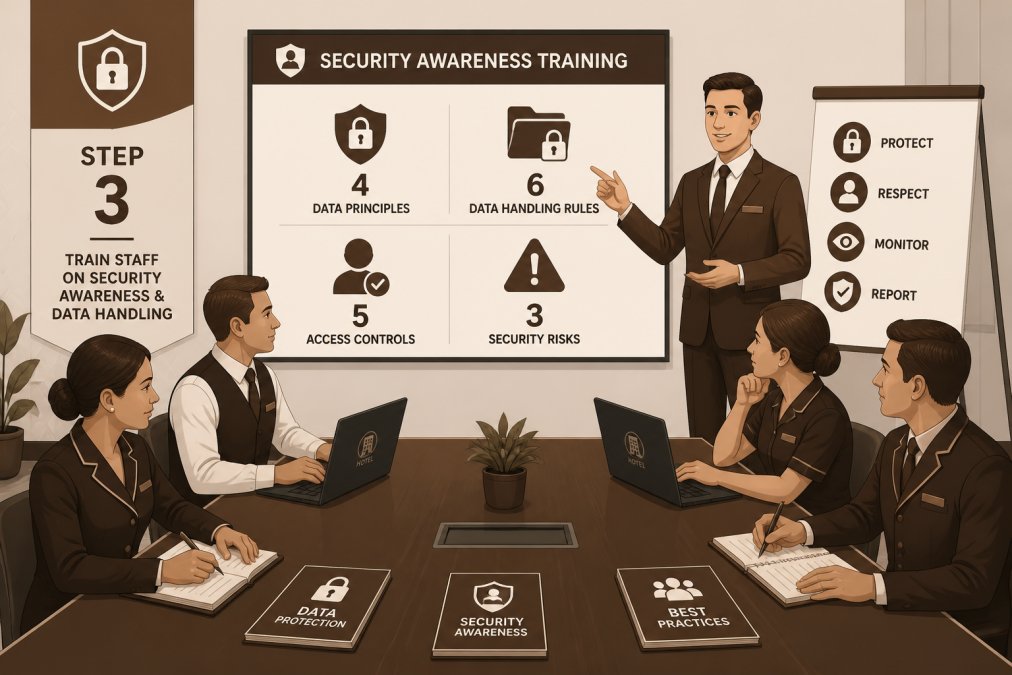
Training should be annual at minimum, with refreshers after any security incident or system change. Short, frequent training sessions (15 minutes monthly) work better than annual full-day sessions. Create a culture where reporting suspicious activity is rewarded, not punished.
Step 4: Establish Regular Security Audits and Vendor Risk Management
Security is continuous. Regular audits identify gaps before they become breaches. Vendor risk management ensures your partners meet your security standards.
Conduct internal security audits quarterly. These can verify access controls are working, encryption is active, inactive accounts are disabled, password policies are followed, integrations use current protocols, and backup systems function properly. Document findings and track remediation.
Vendor risk management means assessing third parties who access or process guest data. Before integrating a new system, request security certifications (ISO 27001, SOC 2, or equivalent), details on encryption practices, incident response processes, FADP compliance confirmation, and data retention and deletion practices.
Create a vendor assessment template and apply it consistently. A simple spreadsheet tracking vendor name, data accessed, security certification status, and last review date is sufficient. Review vendor security practices annually.
How to Handle Guest Data Breaches
Despite best efforts, breaches happen. What separates a manageable incident from a disaster is preparation and response speed.
Incident Response and Guest Communication
Create an incident response plan before you need it. The plan should identify who decides whether an incident is a "breach" requiring notification, who is responsible for immediate containment, who manages guest communication, who handles regulatory notification, and who coordinates with external specialists.
When you discover a potential breach, your first action is containment. Isolate affected systems to prevent further data loss. Preserve evidence. Then assess scope: what data was accessed, for how long, by whom.
Guest notification is required under FADP if the breach creates a risk to guest rights or freedoms. Notification must explain what happened, what data was affected, what steps you're taking to address it, and what guests should do to protect themselves. Notification should happen without unreasonable delay, typically within days.
Transparent, timely communication preserves trust more effectively than attempting to minimize or delay disclosure. Guests who learn about a breach from news reports rather than from you lose confidence entirely. Document everything for required FADP records and potential regulatory investigation.
Building Guest Trust Through Transparent Data Practices
Secure guest data management ultimately succeeds based on guest trust. Guests who trust your data practices share more information, allowing better personalization and service.
Transparency starts with a clear, accessible privacy policy. Consider a two-tier approach: a brief, plain-language summary explaining what you collect and why, plus a detailed policy for guests who want specifics.
Communicate your security practices to guests in terms they understand. "We encrypt all payment information using banking-level security" is more meaningful than technical jargon. "Your preferences are stored only on secure servers in Switzerland" is more reassuring than abstract statements.
Give guests control over their data. Allow them to access what you've collected, correct inaccuracies, and delete information they no longer want stored. These aren't just regulatory requirements, they're trust-building practices.
Platforms like The-Guest Club demonstrate that guest data protection and personalization aren't opposing goals. By hosting guest profiles in Switzerland with privacy-first design and giving guests portable profiles they control, the platform shows guests own their preference data and choose which properties can access it. Hotels get richer guest intelligence because guests trust the system.
Communicate your commitment to data security in your marketing. Luxury travelers increasingly prioritize privacy. Highlighting your Swiss data hosting, encryption standards, and transparent practices attracts guests who value discretion and security.
Secure guest data management is a foundation for delivering the personalized, trustworthy service that luxury guests expect. Hotels that implement strong encryption, access controls, staff training, and vendor management reduce breach risk substantially while building the guest trust that drives loyalty and premium pricing.
The framework exists. The tools exist. What separates hotels that succeed is commitment to making data security a core operational practice. Start with the steps outlined here: encrypt and control access, secure your PMS, train staff, audit regularly, and prepare for incidents.
For properties seeking to accelerate this process while offering guests meaningful control over their data, platforms designed specifically for luxury hospitality, like The-Guest Club, which provides Swiss-hosted, guest-controlled profiles with privacy-first architecture, can integrate seamlessly into your existing systems while enhancing both security and personalization. The combination of strong technical controls and guest-centric data governance builds lasting competitive advantage in modern hospitality.
Frequently Asked Questions
How does the Swiss Federal Act on Data Protection (FADP) apply to hotels?
The FADP requires hotels to process guest data lawfully, transparently, and for specified purposes only. Hotels must implement appropriate technical and organizational measures to protect PII, obtain valid consent for data processing beyond essential reservation data, and respect guests' rights to access, correct, or delete their information. Hotels operating in Switzerland must appoint a Data Protection Officer if processing sensitive data at scale, and must report data breaches to the Swiss Federal Data Protection and Information Commissioner (FDPIC) within 72 hours of discovery.
What are the best practices for storing guest data in Swiss hospitality?
Store guest data using AES-256 encryption or equivalent standards for data at rest, and TLS 1.2 or higher for data in transit. Limit data retention to what's necessary for the guest relationship and legal obligations (typically 3-5 years for transaction records). Use data minimization principles: collect only what you need. Implement role-based access control so staff can only view data relevant to their job. Regularly audit who accesses what data, and maintain secure backups in Switzerland or EU-compliant facilities to meet FADP data sovereignty requirements.
What should a hotel do immediately after discovering a guest data breach?
Isolate affected systems to stop the breach, document what data was compromised and how many guests were affected, and notify your legal and insurance teams. Report the breach to the FDPIC within 72 hours if it poses a risk to guest rights. Communicate directly with affected guests within 30 days, explaining what happened, what data was involved, and what steps you're taking. Offer credit monitoring or identity protection services if appropriate. Conduct a post-incident review to identify how the breach occurred and implement corrective measures to prevent recurrence.
How do I ensure my hotel's PMS is compliant with Swiss privacy laws?
Verify that your PMS vendor has signed a Data Processing Agreement (DPA) compliant with FADP requirements. Confirm the system uses encryption for guest data, supports role-based access controls, and maintains audit logs. Request a recent security audit or penetration test report from the vendor. Ensure the PMS is hosted in Switzerland or an EU jurisdiction with equivalent data protection. Test backup and disaster recovery procedures annually. Conduct regular vulnerability assessments and patch management, and verify the vendor has incident response procedures in place.
This article was written using GrandRanker
Frequently Asked Questions
How does the Swiss Federal Act on Data Protection (FADP) apply to hotels?
The FADP requires hotels to process guest data lawfully, transparently, and for specified purposes only. Hotels must implement appropriate technical and organizational measures to protect PII, obtain valid consent for data processing beyond essential reservation data, and respect guests' rights to access, correct, or delete their information. Hotels operating in Switzerland must appoint a Data Protection Officer if processing sensitive data at scale, and must report data breaches to the Swiss Federal Data Protection and Information Commissioner (FDPIC) within 72 hours of discovery.
What are the best practices for storing guest data in Swiss hospitality?
Store guest data using AES-256 encryption or equivalent standards for data at rest, and TLS 1.2 or higher for data in transit. Limit data retention to what's necessary for the guest relationship and legal obligations (typically 3-5 years for transaction records). Use data minimization principles: collect only what you need. Implement role-based access control so staff can only view data relevant to their job. Regularly audit who accesses what data, and maintain secure backups in Switzerland or EU-compliant facilities to meet FADP data sovereignty requirements.
What should a hotel do immediately after discovering a guest data breach?
Isolate affected systems to stop the breach, document what data was compromised and how many guests were affected, and notify your legal and insurance teams. Report the breach to the FDPIC within 72 hours if it poses a risk to guest rights. Communicate directly with affected guests within 30 days, explaining what happened, what data was involved, and what steps you're taking. Offer credit monitoring or identity protection services if appropriate. Conduct a post-incident review to identify how the breach occurred and implement corrective measures to prevent recurrence.
How do I ensure my hotel's PMS is compliant with Swiss privacy laws?
Verify that your PMS vendor has signed a Data Processing Agreement (DPA) compliant with FADP requirements. Confirm the system uses encryption for guest data, supports role-based access controls, and maintains audit logs. Request a recent security audit or penetration test report from the vendor. Ensure the PMS is hosted in Switzerland or an EU jurisdiction with equivalent data protection. Test backup and disaster recovery procedures annually. Conduct regular vulnerability assessments and patch management, and verify the vendor has incident response procedures in place.